Food or Education?

Many colleges and universities have wealthy dining halls where students eat luxurious meals. On the other hand, there are also many where students are lucky to even get some fresh fruit. In episode 5 of the Revisionist History Podcast, “Food Fight”, it explains the injustices that occurs in colleges. Without even realizing it food plays a big role in it because better food quality means more money. More money means that they spend less on finanicial aid and helping those in need, specifically the lower class. As a result, those of the poorer class attend these schools.

In my personal opinion, food is not my most important concern when figuring out college. Which means that I am fine with the fact that the food is not great. Other alternatives can be easily found like cooking or eating out. Students should be there for the education rather than worrying if they are going to get a five star meal. That money that goes to the meals can be easily used elsewhere especially to help students in need. At the same time, these schools heavily rely on those who pay full tuition which makes it crucial for them to not lose the wealthier students interests. The upper class expects a five star college, however, they have to realize that it is a college not a hotel.

I never payed too much attention to the food that they serve in colleges, and I wouldn’t have realized that it connects to the social injustices. Many people, especially the wealthy, ignore those who are lower class and treat them differently. When in fact their wealth has nothing to do with their knowledge. I believe that they deserve the same opportunites that other students do, therefore, changes should be made in the school system. In order to accomodate for them so that they can fit them in as well. College is about the education not about the wealth. Students are expected to pay an enourmous amount of money when in reality those of even the middle class may not be able to pay it. As a student still in high school, I feel sadden when I look at the tuition of colleges I want to go to. It goes to show the kind of people that colleges or universities expect in their campus. There are so many students who are incredibly smart and deserve to go to those colleges, however, the large tuition holds them back. Some may even not want to apply because of it, and I feel like I was able to relate to that as well.

It’s Not As Easy As It Seems

In the United States of America an amazing school system is expected, however, the reality is that only the upper and middle class get that privilege. In the podcast, Revisionist History, Episode 4, “Carlos Doesn’t Remember” explains the facade of the capitalist society. One specific student, Carlos, is extremely smart, but the main thing that holds him back is his economic situation. However, with the thanks to the Yes Program he was able to go to a private school and given a better education system. This podcast episode really impacted me because it just goes to show how differently minorites are treated, and their world is so different than those of a higher class.

The school system wants every student to succed, yet in reality the wealthy end up getting more help. On the other hand, there are students like Carlos who are extremely smart yet just don’t have all those resources available. Due to living conditions, money, school, and other factors education is not the first thing that they worry about. In the location that was used in the podcast it explained how the school looked like a concentration camp. If a student were heading there they would not be exactly motivated to succed in school. Not only that, but many families encourage their kids to drop out or to focus on working because of how bad they are financially. However, that does not mean that they are not smart, in the episode it explained just how many students are smart but just do not have that same privilege. It’s saddening because there are students at an actual nice school who aren’t as smart as them, yet end up getting a better future.

One recent example of privilege is Lori Loughlin, a famous actress, who bribed her daughter’s way into USC . Her daughter, Olivia Jade, brought to social media to say how she “didn’t care about school and was only there for the parties”. Not only is that incredibly disrespectful but it is also taking the spot away from other hard working students. Meanwhile, Jade attends a college that she is not supposed to be at while hundreds of other students work extremely hard just to go to a nice school.

On top of that Ivy League colleges say that they will help the poorer class, yet fail to do so. Which just goes to show that they are only trying to make their image look good without having to actually do it. This angers me because I know many people who are incredibly talented and smart, and the only thing holding them back is money. Just because someone isn’t in the same financial situation does not mean that they are dumb. In reality they are even smarter than the average student since they do not get that extra help, and have to deal with outside factors like family situations.

The message that the narrator, Malcolm Gladwell, said at the end was something that I liked. He explained how we shouldn’t feel inspired or in any way relieved since Carlos did this with the help of an organization that came to him. Many see that program as the opportunity to say that action is happening when in reality it is not helping every student. It is rare for others to get that same kind of treatment, and it shocked me how this organization scoutes students since elementary school. Growing up in an environment like that other factors get in the way, and they eventually lose their potential. This really spoke to me, and it showed how minorites are pushed aside especially people of color. The American society only wants the wealthy to succed while they stereotype others.

A Picture Tells All

A picture paints a thousand words without having to use any words. Some pictures point directly to the intended message while others leave it up to debate for the audience. However, Kim Kyung Hoon captures a powerful picture of a migrant family running from the tear gas at the border. Without using any words or forms of persuasion the photographer is able to capture the sad reality that many Americans ignore, and it is found through a series of analysis. In one simple image that is not staged Hoon was able to move millions just by capturing the chaotic setting from the children falling to the fear in the mother’s eyes. The American flag in the background and the border that is not too far away play a significant role.

On November 25, 2018 tear gas was thrown at the border between the United States and Mexico. President Trump is well known for his strong beliefs against immigration and issues with the border. He is not afraid to hold back on his opinions that go with that as well as pushing to build a wall. As a result, he ordered the tear gas to be thrown which caused thousands of families to frantically run away and also get arrested. One specific family, the Meza family, were traveling from Honduras searching for a better life and hoping to escape the terrible violence and poverty. Kim Kyung Hoon, a Veterans Reuter photographer, was traveling alongside the migrants when he captured the chaotic and saddening image of the Meza family. The mother is seen trying to get her two twins up while others stand around in the background.

The image went viral for many reasons and did not need an explanation in order to do so. The viewer sees the poverty that the migrants are facing due to the two children at the focal point being without shoes and in diapers. Both children faces are covered with their hair, as they are seen falling. Their mother struggles to pick them up and her fear and frustration can be seen through her facial expression. On the left corner, the tear gas can be seen where it slowly makes its way throughout the scene. The family is the focal point at the center of the photo and behind them are clumps of people, some running while others are unsure of what is happening. The woman of the two children is wearing an Elsa shirt that states, “family forever”. Almost a bit ironic since she is saving her children. Another photographer is also seen in the background taking a separate image. Not too far away stands the border fence where men can be seen trying to get through. Then, behind them waves the American flag which also holds a bit of irony since this was an inhumane thing to do. The American flag holds an incredible amount of power since it is a nation that has freedom and is seen as a welcoming place. However, this incident contradicts what America stands for.

Hoon’s image went viral and many felt empathetic towards the incident, however, this visual text could be reconstructed in order to properly evoke the message. The photograph was sent out just by itself with no words included on it. After the image went viral, Hoon had an interview with Time Magazine where it states, “He adds that he does not want to tell people how to feel about the photograph, but hopes that it will bring the situation at the border greater attention” (Time, Law). It is up to the viewer to make the choice on what to believe and how to feel about the incident. Therefore, if one were to reconstruct the image in order to get the audience to feel bad for the migrants and show America’s actions as inhumane certain elements can be added. First, there could be police officers or other forms of agents included in the image in order to properly show them as the “bad guy”. They can all be lined up alongside the fence holding guns and not allowing the migrants to get through. By including the officers it helps to show that the situation was as bad as some made it seem. It is a controversial topic since technically what the migrants are doing is illegal, and in a way, the United States did have a right to do that. Therefore, the picture needs to involve more violent or chaotic aspects in order to show that what America did was wrong. As a result, another tear gas can be added to the image and even closer to the groups of people. The people can be running rather than standing around showing a strong sense of panic. More people can be seen falling or trampling over each other while parents carry their children.

Without using any words Hoon’s photograph of the migrant family getting tear gassed at the border went viral. This photograph captured what was going on behind the wall, and what many Americans choose to ignore. The President of the United States ,as well as many others, are calling these people bad and violent. However, they are the ones demonstrating those actions by throwing the tear gas rather than going about it in a peaceful manner. Innocent families who just wanted to have a better life were so close until they had to run for their lives. With the help of Time Magazine, Hoon was properly able to share his story as well as the family’s story that was in the photograph. It helps to demonstrate that what was done was not right, and this picture was only the beginning of the incident. More chaos occurred after it was taken since the picture was captured right when the first tear gas was thrown. The American flag should not be proudly standing in the background while women and children are fighting to live on the other side.

Works Cited

Law, Tara. “The Story Behind Photo of Family Running From Tear Gas at Border.” Time, Time, 27 Nov. 2018, time.com/5464560/caravan-mexico-border-iconic-photo/.

An Escape For the Wealthy

One of the many things that wealthy people spend their money on is golf. When one envisions golf they see a wealthy white man wearing a polo outfit in a beautiful green landscape. In the Revisionist History Podcast, Season Two, Episode 1 explains how the wealthy are addicted to golf and how it is unfair to regular people. Malcolm Gladwell’s, the narrator, main argument in ” A Good Walk Spoiled” was that the Golf Country Club holds a perfectly good park, yet it is out of reach to the general public. Living in a place like Los Angeles where there really are no parks this can make the general public frustrated.

I’ve never understood why rich people are crazy about golf, and in all honesty I’ve never seen golf as something fun. Instead I see it as something luxurious because in a way it is. People can really tell how much money goes into it just by the way the greenery is kept. I’ve past by many golf courses and I’ve always wanted to go inside it not to play golf, but rather just because of how pretty it is. Therefore, I understand the narrator’s frustration and argument of wanting to use it for running but instead having to use a dirt pavement. Country Clubs should be open for public use because it is in the middle of the city, however, that would take away from the wealthy. What the wealthy want is their privacy, so if it were open to the public then the value of it would go down.

Not only does it show the power and privileges that the wealthy have but it also shows the corruption. Golf courses do not pay the normal amount of tax that they need to pay, and instead they pay even less. Due to a certain law that stated that properties before a certain time period only need to pay a small amount of tax, golf courses have been able to avoid paying it. Which I believe is unfair since they clearly have enough money to pay it, and if other properties are paying it they should too. Not only that, but many famous politicians including the current President of the United States, Donald Trump, spends a large amount of time playing golf. Time that could be spent helping the nation and figuring out how to resolve economic problems. Therefore, it is kind of funny how gold courses get a certain privilege when it comes to taxes since many government officials use it for their own benefit.

Not only are golf courses expensive, but not just anyone can go there. Meaning that you have to be approved to get in which is where racism and discrimination can get involved. When it comes to the wealthy, they hold a large amount of power simply due to their status, and they are all about keeping their image clean. Therefore, you won’t really find a person of color playing golf. This simple sport in a way signifies the power of the wealthy and the privileges they have. For everyday people, like me, it is unfair and makes me feel like I’m living in a seperate world from the wealthy. In a way it even shows the ignorance of the wealthy since they do not have to face the poverty behind the fences.

Structuring Pieces of Writing

“As a Result”: Connecting the Parts- In the textbook, They Say, I Say authors Graff and Birkenstein explain the concept that each sentence should flow easily from one another. In other words, meaning that sentences should connect to the previous sentence. At the beginning of the chapter, the auhtors give an example of a student named Bill who had trouble tying his sentences one another, making it difficult for the reader to read. Later on, Bill mention that some of his errors were not rereading what he wrote, and only being focused on the future sentences. In order to avoid this mistake transitions, key terms, pointer words, and more should be used. These help repeat the main points as well as keeping the readers attention. Repeatition is extremely important, however, it should be altered in order not to sound monotonous. Therefore, the reader is able to understand and reminded of the claims. The connection between sentences helps make it comprehensible for the readers as well.

What I Learned: I learned that reptition is crucial but each time you repeat it should be done differently. Much more thought has to go into reptition rather than just simply restating.

“Ain’t So / Is Not”: Academic Writing Doesn’t Always Mean Setting Aside Your Own Voice- In this chapter, the authors demonstrate how many people associate writing with formal language. As a result, they do not like to write since it may bore them, or they simply feel that it isn’t truly them. Therefore, the authors explain that the two languges can be mixed which is both formal writing language as well as everyday slang. There can be a nice blend of each while still getting your point across without confusing the audience. However, there are instances where it shouldn’t be used like a job proposal or something formal. Writing does not have to be so uptight all the time, and you can still add your own personality.

What I Learned: I always associate writing with extreme formality, and with this chapter it shows that not all writing is like that. I learned that you can still add your own writing style and slang into it.

“But Don’t Get Me Wrong”: The Art of Metacommentary: When people first hear the word “metacommentary” they are confused and unsure of what it means. What they do not know is that it is constantly being used in daily converstations and in text. Metacommentary is when you explain what you have already said, and telling other how or how not to think about them. Examples of this is, “I’m not saying” or “what I meant to say”. Metacommentary is important because it helps from getting the reader or the audience confused. Adding this side comment helps refresh and simply shorten your previous claims. Tittles and subheading constantly use metacommentary in order to give a short glimpse of the piece of text. In short, metacommentary helps elaborate and clarify something already stated.

What I learned: I learned what metacommentary was and how I use it without even knowing it.

“He Talks About Deplores”: Using the Templates to Revise: Revision is extremely important, but many do not know where or what to revise. Therefore, this chapter provided a checklist of what to do after writing an essay. All the notes that they gave were from previous chapters and claims which were all tied together. Ranging from transitions to metacommentary it shows where in the textbook you can find help on it. In the chapter, a student sample of a revised essay is also provided.

What I learned: Just because you are done writing an essay does not mean that you are done with everything. Revision is just as important and should not be overlooked.

A Picture Paints A Thousand Words

A mother and her two twins at the Border running away from tear gas in Tijuhana.

  1. Kim Kyung Hoon took this pic, he is a Veteran Reuters photographer. TIME Magazine held an interview with him where they wrote an article over the whole situation. Kim is extremely credible since this is his profession, and he had been camping out alongside the immigrants. In order to share their living conditions and why they were doing what they were doing.
  2. The intended message is to show the cruelty and inhumane conditions that immigrants are facing by the United States. Kim wishes to show how immigrants are people too and most are just in search of a better life. In the interview, Kim states “I just want to show what is happening here to another part of the world.”
  3. The actual image is not persuasive because it is just showing the sad reality that immigrants are facing at the border by being tear gased. Time Magazine actually explains, “He adds that he does not want to tell people how to feel about the photograph, but hopes that it will bring the situation at the border greater attention.” Kim is not trying to tell people what to think or persuade them but rather just bring attention to the situation. Ethos is used since Kim had been following them in the caravan for weeks, and share the voice of those who do not have one. Pathos is also used because chaos is easily seen in the image as well as two yound children unsure of where to run. With their mother that has fear in her eyes, and is desperately trying to save her children.
  4. The intended audience is America because of the President Donald Trump and his forceful actions to build the wall. The U.S. border agents were the ones to throw the tear gas, and it sends a message that America as a whole contributed to this. Therefore, it cannot go unnoticed and action should be taken to end this cruelty. It is also for those who support Trump and his actions, so that they can realize how many people and innocent families are being hurt.
  5. Time Magazine delievered the story when they interviewed Kim. Kim published the photo not realizing that it would go viral. In Tijuhana, Mexico on November 25, 2018 U.S. border patrols threw tear gas at immigrants trying to cross the border. Many of them were women and children who had to run for their lives. There were two men trying to dig their way under the fence with their barehands when the incident happened. The children in the pictures are 5 year old twins and their mom is Maria Meza. After everything went down Kim interviewed them and asked about her background. She says she was looking for a better life away from the violence in Honduras. She was also traveling with three other children. Meza said she was shocked that they would try to hurt women and children like that.

Semiotic Elements

  1. Symbolic: The main subjects in the photo is the woman pulling up her two children. Both children are seen in diapers and bare fragile feet while on the rough dirt ground. It is captured during daytime and there is a slight almost gone river behind them. On the left side is the tear gas canister with smoke. Further behind that is a group of people some standing around not sure what to do and others running. Another photographer can also be faintly seen in the background capturing the chaos. The barbed wire fence is seen as well as the border wall not too far from them. Behind the border the America flag is shown showing the opposite of what America should be. Everyone seems frantic and the main woman has fear in her as well as a frustrated face. Her shirt is ripped and features Elsa showing the poverty that they live in. Neither of her children face the camera and are almost falling.
  2. Written: The caption featured is “A migrant family, part of a caravan of thousands traveling from Central America to the United States, run away from tear gas in front of the border wall between the U.S. and Mexico in Tijuana, Mexico, on Nov. 25, 2018. ” It is straight to the point and brings attention to the situation. Time Magazine share the background and context of the picture that went viral. The article is written by Tara Law where she explains the entire situation while remaining unbiased.

You Can’t Eat That

Food is essential to life and meat plays a huge role in that, however, there has been inequalities that have arisen in the food realm. Men have been stereotyped to be huge meat lovers, and if they eat healthy then it lowers their masculinity. On the other hand, women have been stereotyped to eat healthy and have more plant based diets. This has not been something that all of a sudden formed, but rather started during the hunter and gathers time period. In the article, “Having It His Way” by Carrie Packwood Freeman and Debra Merskin it illustrated how masculinity has been constructed in fast-food advertisements. It shows how men are in a way ashamed to eat healthy or have a plant based diet. As someone who is vegetarian, I was not able to wrap my head around why most men are so afraid to lose their masculinity. Just because they take care of their health and eat healthy foods should not make them any less of a man. To me it makes no sense why they would feel the need to fill their body with unhealthy substances and loaded with meat just to protect their masculinity.

When the domestication of animals occured, a long time ago, women were most likely the ones to invent plant argiculture. While, men were in charge of hunting animals and bringing home the meat. Therefore, this helps explains where these sterotypes arose. However, this was thousands of years ago, so things don’t have to be the same now. The authors included how Ecofeminism is the idea that females draw on the concept of gender to theorize on the relationship between humans and the natural world. They add to the conversation by applying how women are seen as objects or even worse just another meal. In fast food commercials the audience targeted is males which is something that the companies do not hide. In their slogans the word “man” is used such as Burger Kings, “Have it your way” commercial. In this commercial they clearly mock the feminist movement by using a parody of a feminist song. Being a female, this makes me mad because I feel like there was no need for them to do this. They could have just done a commercial to actually advertise their product rather than going out of their way to mock women.

Burger King was not the only one to fall into the growing of masculinity with food, but also many other companies. It was shocking to me to see how many other fast food companies made sexist commericals, and they felt that it was ok to do. In my opinion, I don’t see why the would feel the need to even make their commercials gendered since they are only advertising food. For example, in the article it explains how Carls Jr. made a commercial where a guy was fully checking out a girl while with his girlfriend. Then, afterwards mentioning that “it is more fun to eat wings when out with the guys”. If I saw this on TV I would be offended since it lowers a women’s status and also promotes a sense of cheating. Along with this, when women are featured in fast food advertisements they are only seen as objects meaning that they are sexualized and do not talk. Jack in the Box, Arby’s, Quizno’z, Subway, and more all contribute to this discriminations,

Meat is seen as this glourious thing to men when in fact the meat industry is extremely harmful. The animals are inhumanely killed, it contributes to global warming, labor explotation, and causes diseases. Yet, most men and even females fail to see this and continue eating meat. These are actually the reasons why I am vegetarian, and I am not angered at others for eating meat but it is kind of disgusting when they glorify it to such a huge extent. It also makes me mad when they immediately come for those that are vegan or vegetarian just because they don’t eat meat, and they go to the extent to mock them. It’s surprising how people especially males see healthy food as something peculiar. For example, when I cook meals at home my dad refuses to eat it because it’s “too healthy” or the fake meat seems “gross”.

Gender inequality is something very revelant in the fast food industry and food all together. The authors of the article help make that clear and even help show the root of it all. To me, it makes no sense why people have to sterotype food or why men refuse to eat healthy. However, this day in age eating healthy has grown greatly and more people have switched to plant based diets. Hopefully, with time men and women can eat whatever they want without having to feel discriminated. As well as, women no longer being viewed as objects when it comes to food advertisements.

Answering Arguments

“Yes / No / Okay, But”: Three Ways to Respond- In the textbook, They Say I Say, authors Graff and Birkenstein demonstrate how many people struggle when it comes to stating their position in an argument. When one responds to another person’s argument there are three ways to go about: agreeing, disagreeing, or a combination of both. Trouble forms when responding since many people fail to state their stance which leaves the audience confused. Students and other people are afraid to explain their stance because they do not want to seem unoriginal by agreeing, harsh by disagreeing, or unconfident by doing both. Therefore, when stating one’s stance it is crucial to back it up by evidence and by bringing in new ideas to the table. As a result, they are not just repeating what other’s are saying, and they are clearly showing their argument. The explanation portion is even more important when disagreeing since they have to support their new argument. The authors also explain how an argument can be tipped to one side more than another when combining the two stances. The authors provide specific quotes and examples to support their argument.

What I learned: When I have debates in some of my classes I get scared to provide my own stance. As a result, I end up just confusing the audience, so this helped me understand how to properly develop my argument.

“And Yet”- When it comes to referencing other’s, things tend to get a bit confusing on who is saying what. Therefore, it is important to take certain steps in order to distinguish what they say versus what you say. Voice markers are essential when distinguishing the different perspectives. “So it would seem”, “yet”, “result”, and more are all examples of voice markers, they are phrases or words to help show a perspective. The authors give an example of a text by Gregory Mantsios, and they analyze the text in depth. Mantsios uses a series of voice markers to get his message across without using phrases like “I say” or “I argue”. Many readers fail to comprehend the voice markers, causing them to become confused about who believes what. In this chapter, the authors also contradict the common belief that first person should not be used. “I” can be used as long as it is supported by evidence and a solid argument. However, there are instances where first person should not be used in order to make the paper not seem monotonous.

What I learned: It is easy to get confused when it comes to distinguishing who is saying what. I use voice markers without even realizing it most of the time. When reading other people’s writing you really have to look out for the voice markers to comprehend the text.

“Skeptics May Object”- Many people choose not to face their criticisms since they do not want to think of their work as bad. However, these critiques can be used in one’s own text, and it ends up benefiting them. A rebuttal, or a naysayer can add credibility in one’s text. By pointing out the criticisms and providing evidence to go against that, it makes the author seem confident and trustworthy. By acknowledging the other side it shows how you pointed it out before other’s could beat you to it. In the end, you are not only prepared, but also, with the proper evidence to support your argument. The authors of the textbook give an example of a chapter of a book dedicated to a naysayer by Kim Chernin. It explains how Chernin embraced the counter argument and fully supports her side. In the naysayer, a label can be used in order to address the audience that would be critiquing it. In doing so, it is important to refrain from stereotypes and to keep things professional. However, objections can be introduced informally as well in the form of a question or the naysayer can speak directly. Even though it is informal, the writer shouldn’t get too carried away and mock the other side. The naysayer should also be something that you can easily argue and you have solid evidence on. By providing a naysayer, it adds credibility, answers questions before being asked, acknowledges the other side, and more.

What I learned: In school, I’ve always been taught to provide a naysayer in my essays or reports. Therefore, this chapter was a bit of a review for me. It helped me refresh those key points and how to accomplish going about a naysayer.

“So What? Who Cares?”: When giving a speech, lecture, writing a piece of text it is important to identify why the audience should care. In many scenarios people are left with the questions, “So what?” and “who cares?”, they wonder why the argument applies to them. Therefore, these questions should always be answered in every text or speech in order to properly gain the audience’s attention. In most instances, the writers and speakers assume that the audience already knows, but that is not true. Answering who should be affected by this and why, it helps avoid confusion. A passage from the science writer Denise Grady about fat cells is used as an example of these questions being answered. The authors then analyze this passage in great depth. These questions need to be answered as far as possible.

What I learned: I realized how important it is to answer these simple questions. You can give a great speech or write a great essay, but if you don’t touch on this then it can leave the audience confused.

The Moral Argument

In the article, “Is abortion morally wrong?” written by Jessie Blaeser, an argument is presented about the morals of abortion. Blaeser maintains an unbiased stance throughout the text and leaves her main question, the title, open for the readers to answer based on the evidence she provided. She provided both points of views of Pro-Life advocates who believe that abortion should be illegal since a fetus is a person. Therefore, abortion is murder, however, the other side states that females have the ability to choose what she wants since it is her body. The writer goes equally into depth on both sides and provides many different pieces of evidence. Statistics, court cases, regular opinions, and surveys are included. Blaeser also conducted a poll of whether abortion is morally wrong or right where it was up to the audience to make the decision. The audience chose morally wrong, however, she did not touch or mention the answer showing how she is unbiased and just stating the facts.

Rhetorical Situation:

Author’s background: Jessie Blaeser is an editor and writer at The Tylt which is an online website where opinions can be heard and explained. She is a proud millennial, and has her own website where she shares her work which is writing.

Target Audience: This is targeted for those who are not sure whether abortion is morally wrong or not. It is also for those who are really biased to see the other side.

Context: Due to Brett Kavanaugh’s confirmation to the Supreme Court, this debate was brought back up of whether it should be legal or not.

Argumentative Elements:

Main Argument: The main argument is whether abortion is moral or not, and as a result of that, if it should be legal or not.

Claims: The author states how Pro-Life advocates say that “abortion is immoral because even an undeveloped life is still a life, and therefore, no one has the right to take that life away” (Beaser). It then goes into the Science of it by demonstrating how a fetus is a life and that abortion is murder. On the other hand, Pro-Choice advocates take into question of how the fetus life will be outside the womb since they could be mistreated due to certain living conditions. It also goes in depth to say how women have the right to choose what to do with their body, and they have the freedom to make those decisions.

Evidence: Many different pieces of evidence was used to back up the text ranging from statistics to quotes by professionals. A graph was used to show how many people voted whether abortion should be legal or not. Quotes from the Supreme Court and different laws were mentioned as well. As well as, the publics opinion on abortion and their stance on it. Different personal experiences of abortion is also used. A quote from a Scientist also is used to explain the science behind a fetus’ life. Other opinions and professional quotes are used as well to support the claim, and a poll is even conducted.

Evidence Appeals:

Logos: The author does a good job of using logical arguments by providing many different statistics and graphs. These pieces of evidence relate directly to the topic and are explained in depth as well.

Ethos: Blaeser is a young female which makes her a bit credible since she could be affected by this. She builds credibility through her examples and solid evidence used. She also does not put her opinion in there which shows she is unbiased and just presenting the facts.

Pathos: The author refrains from using emotional appeals in order to make the argument more valid and unbiased. More technical vocabulary is used and each side is presented equally.

Definitions: Everything in the article is pretty straight up, and even though, many technical terms are used it is explained afterward. More advanced terminology is used, however, it is not to the point where it difficult to understand or read.

Arrangment/Organization:

Consistency: The text is consisent and set up where each side is divided, therefore, it is not confusing. It first describes the argument as a whole then it presents Pro-Life advocates stance. After that, it presents Pro-Choice advocates stance and it goes in deoth.

Arrangment: Yes, the claims are extremely understandable since each side is divided.

https://thetylt.com/culture/abortion-ethics

A Leap Of Faith

Evidence plays a big role in order to make something true, therefore, the evidence that is used must be logical and fit with what it is proving. According to the passage, Evidence, the author makes the point that there are many flaws in how humans get their evidence, and what they conclude it as. Descartes further elaborates this, in his idea of error which explains that believing something based on insufficient information can lead to errors. Throughout the passage, however, it is discovered that his idea was only half correct.

When we come to conclusions most of the time they are based on prior knowledge, experience, beliefs, and more. This strategy is called inductive reasoning and is the leading candidate for actually being human intelligence. As an example, the passage gives a simple quiz with questions like, “The giraffe had a very long…” As soon as a person sees this the answer, “neck”, comes into mind since almost everyone knows that giraffes have very long necks. Therefore, inductive reasoning is being used when answering this question. On the other hand, the passage gave an example of a computer taking the quiz, and the results were incredibly different and almost ridiculous. This is because computers recognize that there is an infinite number of logical and theoretically valid answers to these questions. As smart as a computer might be, humans can easily differentiate between what is logically valid and what is more probable.

Me jumping to conclusions

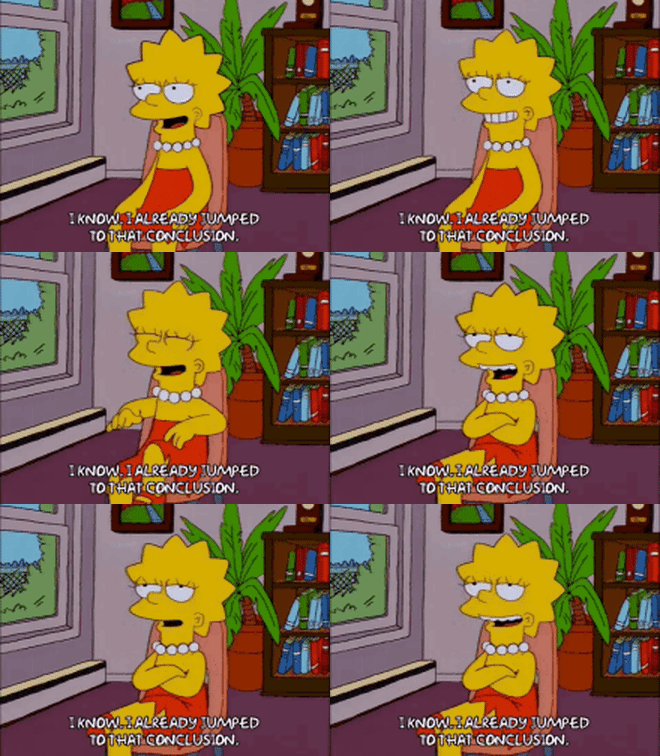
This whole process of inductive reasoning is a bit of what one would call, “jumping to conclusions.” Now, this tends to be a bit of a popular topic on social media where people like to expose others for jumping to conclusions. For example, if someone doesn’t reply quickly they might jump to conclusions and think that the person hates them. As ridiculous as it may sound, I am guilty of this. However, aren’t we all jumping to conclusions every single day of our lives when we use inductive reasoning? Yes we are, however half of the time it works out, and the other half it doesn’t. The part where it doesn’t work out is what really gets the spotlight and enforces the whole idea of taking time and finding proper evidence to support one’s claim. I believe this tends to be biased and it points out our failures rather than the half that was correct. Yes, things should have proper and well -thought out evidence, however, there are certain things where one does not exactly need to go all out. For example, lights are turned on by switches and after seeing that happen for the first few times one can associate them together. Therefore, if a light turned on then one would look for who flipped the switch. We do this without even realizing it, and this shows flaws in Descartes’ principle. In the end, it shows that Descartes’ idea is half right and half wrong.

A flaw of inductive reasoning is leaping to conclusions while ignoring the evidence in front of you. The passage gives an example of a woman named Elizabeth who argued that Orion was not a winter constellation, even though it was her seeing the constellation in Winter that leads her to this discussion. In other words, it is important to do more research when going into arguments and seeing the evidence in front of you. By contrast, other people may view the counter-evidence, but choose to ignore it since it does not help their beliefs. These two examples are called confirmation bias which is the tendency to change new evidence in order to confirm one’s existing beliefs. Another flaw in inductive reasoning is that it easily generates stereotypes. For example, since one Muslim is a terrorist then inductive reasoning leads it to believe that all Muslims are terrorists. I believe that this explains a lot since many people tend to do this, and they do not seem to rationalize or apply common sense to this situation. Just because one person does something, it doesn’t mean that the rest do it as well. Sadly, many people fail to see that since that automatically jump to that conclusion.

One last important flaw of inductive reasoning is that some people believe something so well that they never actually investigate it. In the passage, it gave an example of how it was believed that women had an extra rib, however, not until later did they decide to count them. Another example that comes to my mind is religion. It’s a controversial topic since if one really thinks about it there is no solid evidence that proves most religions. However, religion has this mass following and devotion where no one seems to care about the evidence or not since it is just believed and passed down.

Inductive reasoning is a part of a way of thinking, and there’s a 50% chance that it will be correct. However, despite that people still tend to jump to conclusions, which isn’t a bad thing, only when it’s wrong. At the same time, inductive reasoning is fundamental for humans since it teaches basic habits quickly to children which saves time and effort. This prior knowledge is essential in our daily lives, but at the same thing, it can also make someone look not so smart when it fails. Therefore, it is crucial to find that perfect balance and realize when to jump to conclusions and when not to.

Design a site like this with WordPress.com
Get started