Evidence plays a big role in order to make something true, therefore, the evidence that is used must be logical and fit with what it is proving. According to the passage, Evidence, the author makes the point that there are many flaws in how humans get their evidence, and what they conclude it as. Descartes further elaborates this, in his idea of error which explains that believing something based on insufficient information can lead to errors. Throughout the passage, however, it is discovered that his idea was only half correct.
When we come to conclusions most of the time they are based on prior knowledge, experience, beliefs, and more. This strategy is called inductive reasoning and is the leading candidate for actually being human intelligence. As an example, the passage gives a simple quiz with questions like, “The giraffe had a very long…” As soon as a person sees this the answer, “neck”, comes into mind since almost everyone knows that giraffes have very long necks. Therefore, inductive reasoning is being used when answering this question. On the other hand, the passage gave an example of a computer taking the quiz, and the results were incredibly different and almost ridiculous. This is because computers recognize that there is an infinite number of logical and theoretically valid answers to these questions. As smart as a computer might be, humans can easily differentiate between what is logically valid and what is more probable.

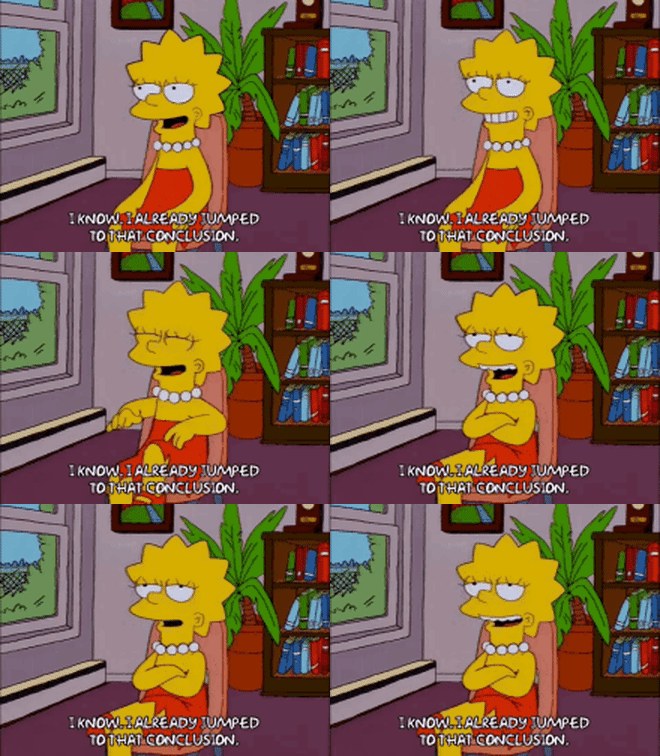
This whole process of inductive reasoning is a bit of what one would call, “jumping to conclusions.” Now, this tends to be a bit of a popular topic on social media where people like to expose others for jumping to conclusions. For example, if someone doesn’t reply quickly they might jump to conclusions and think that the person hates them. As ridiculous as it may sound, I am guilty of this. However, aren’t we all jumping to conclusions every single day of our lives when we use inductive reasoning? Yes we are, however half of the time it works out, and the other half it doesn’t. The part where it doesn’t work out is what really gets the spotlight and enforces the whole idea of taking time and finding proper evidence to support one’s claim. I believe this tends to be biased and it points out our failures rather than the half that was correct. Yes, things should have proper and well -thought out evidence, however, there are certain things where one does not exactly need to go all out. For example, lights are turned on by switches and after seeing that happen for the first few times one can associate them together. Therefore, if a light turned on then one would look for who flipped the switch. We do this without even realizing it, and this shows flaws in Descartes’ principle. In the end, it shows that Descartes’ idea is half right and half wrong.
A flaw of inductive reasoning is leaping to conclusions while ignoring the evidence in front of you. The passage gives an example of a woman named Elizabeth who argued that Orion was not a winter constellation, even though it was her seeing the constellation in Winter that leads her to this discussion. In other words, it is important to do more research when going into arguments and seeing the evidence in front of you. By contrast, other people may view the counter-evidence, but choose to ignore it since it does not help their beliefs. These two examples are called confirmation bias which is the tendency to change new evidence in order to confirm one’s existing beliefs. Another flaw in inductive reasoning is that it easily generates stereotypes. For example, since one Muslim is a terrorist then inductive reasoning leads it to believe that all Muslims are terrorists. I believe that this explains a lot since many people tend to do this, and they do not seem to rationalize or apply common sense to this situation. Just because one person does something, it doesn’t mean that the rest do it as well. Sadly, many people fail to see that since that automatically jump to that conclusion.
One last important flaw of inductive reasoning is that some people believe something so well that they never actually investigate it. In the passage, it gave an example of how it was believed that women had an extra rib, however, not until later did they decide to count them. Another example that comes to my mind is religion. It’s a controversial topic since if one really thinks about it there is no solid evidence that proves most religions. However, religion has this mass following and devotion where no one seems to care about the evidence or not since it is just believed and passed down.

Inductive reasoning is a part of a way of thinking, and there’s a 50% chance that it will be correct. However, despite that people still tend to jump to conclusions, which isn’t a bad thing, only when it’s wrong. At the same time, inductive reasoning is fundamental for humans since it teaches basic habits quickly to children which saves time and effort. This prior knowledge is essential in our daily lives, but at the same thing, it can also make someone look not so smart when it fails. Therefore, it is crucial to find that perfect balance and realize when to jump to conclusions and when not to.
 Words that come to life